


Candy Crush Soda Saga
King
I have always found Candy Crush Soda Saga easiest to understand as a quick, colorful puzzle game that can fit around real life. It is free to start, simple enough to learn in a few minutes, and built around short match-three stages rather than long sessions that demand your full attention. I can play it while waiting for an appointment, take a break after finishing a task, or stop after one level without needing to remember a complicated story.
That accessibility explains why it has remained such a familiar name in casual games. King released it on November 11, 2014, and it now has over 500 million installs. Its average rating is 4.6 from around 8.9 million ratings, with roughly 391 thousand written reviews. Those figures suggest a very broad audience, although popularity alone does not make every part of the experience suitable for every player.
How the soda-themed puzzle loop feels in everyday play
The central appeal is immediate: arrange matching candies, trigger combinations, and clear the board while working toward the level’s objective. The soda theme gives the familiar formula a brighter identity, with fizzy visual effects and a playful presentation that makes successful moves feel satisfying. I do not need a tutorial-heavy introduction to understand what the game wants me to do, which is valuable when I only have a few spare minutes.
Related News

Discover the Magic of My Talking Angela: Your Virtual Feline Friend
Why My Talking Tom 2: Pet Game is Addictively Fun
What makes the game more than a basic matching exercise is the way each board asks me to read the whole layout before making a move. A tempting match may be less useful than a quieter move that opens space, reaches a difficult corner, or creates a stronger combination on the next turn. I get better results when I stop treating every possible match as equally valuable and instead look for moves that change the board in a meaningful way.
That habit is particularly useful in crowded stages. Clearing candies near the middle can create a chain reaction, but it can also leave awkward pieces around the edges. When I am close to completing an objective, I try to preserve moves that can reach those less convenient areas rather than spending everything on attractive combinations early. This is one of the game’s less obvious lessons: a spectacular move is not always the most practical move.
Related News

Why WhatsApp Messenger Still Makes Everyday Communication Feel Easy

Jurassic World: The Game Is the Better Dino Tycoon for Strategic Players

Threads in Real Life: Who Should Join, Lurk, or Leave

How SHEIN Turned Shopping Into an Endless Content Feed

How to Make Fortnite Feel Smarter on Mobile

Should You Switch to Microsoft Outlook on Mobile?
The casual format works well for a realistic daily routine. Imagine having ten minutes before a train arrives. I can open the game, attempt a stage, and put the phone away without losing an hour to a complicated campaign. On another day, I might use it as a mental reset after work. The bright effects and clear goals provide a small change of pace, while the limited space on each board gives me something concrete to focus on.
At the same time, the simplicity can become repetitive if I want deep strategy, character development, or a strong narrative reason to continue. This is a puzzle-first experience. Players who prefer role-playing progression, competitive action, or large worlds to explore will probably find the structure too narrow. I would recommend it to someone who enjoys optimizing small decisions, not to someone looking for a substantial adventure.
Learning to manage the board instead of chasing effects
My most useful approach is to separate immediate progress from long-term board control. If I see a move that creates a special candy, I do not automatically use it at once. Sometimes leaving it in place allows a second combination to form nearby. Other times, delaying it is risky because the board may shift in an unhelpful direction. The right choice depends on the objective and the remaining space, so the game rewards attention more than blind speed.
Gallery
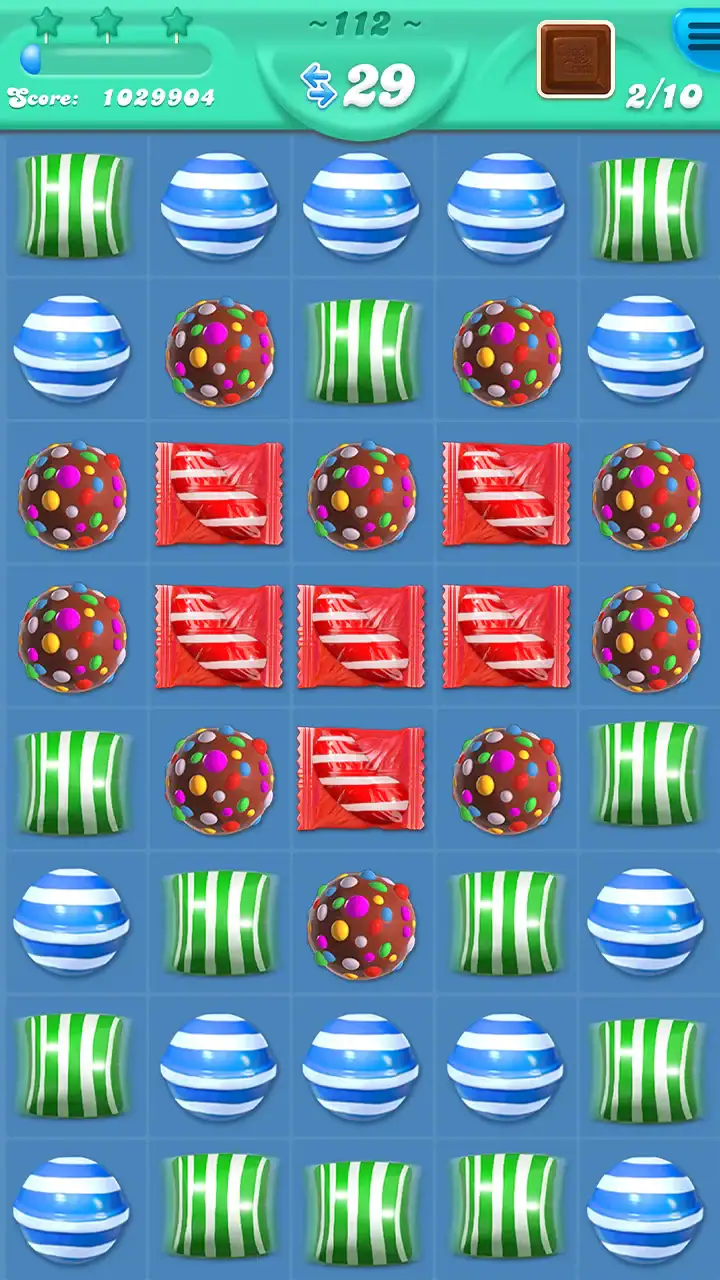
I also try to scan from the bottom upward before moving. Lower matches can cause candies above them to fall, potentially producing free matches that I could not predict from the top. This makes the lower part of the board strategically important, even when the objective appears elsewhere. It is a small change in thinking, but it helps reduce wasted turns and makes difficult stages feel less random.
Another practical tip is to avoid clearing harmless pieces simply because they are available. If a section of the board is already open, I would rather work toward blocked or isolated areas. This matters when a level’s target is spread across the board. A player who focuses only on the easiest visible matches can finish with plenty of activity but still fail the actual objective.
The game’s presentation supports this style of play. Candy colors are easy to distinguish, animations make combinations readable, and the feedback after a successful chain is energetic without requiring a long explanation. I can usually tell why a move worked. That clarity is important in a casual puzzle game because frustration feels fairer when I understand the mistake.
Where progress starts to feel less relaxed
The early experience is welcoming, but the pressure changes when a stage resists several attempts. A failed level can make me reconsider my approach, which is enjoyable when the board offers a clear strategic lesson. It is less enjoyable when I feel that success depends mainly on receiving a favorable arrangement. The difference between those two situations is important: challenge encourages me to improve, while repeated bad layouts encourage me to stop playing.
I also notice a psychological pull to continue after a near miss. Finishing almost everything can make the next attempt feel necessary, even when I originally opened the game for a brief break. That is not unique to this title, but the bright effects, quick restarts, and clear objectives make the loop particularly easy to repeat. I recommend deciding in advance how long I want to play, especially if I am using it late at night or during a busy day.
For players who dislike interruptions to their rhythm, the free-to-play structure deserves attention. The game costs nothing to download, but in-app purchases range from $0.99 to $149.99 per item. The existence of that range does not tell me how often purchase prompts appear or how strongly they affect a particular stage, so I would not assume that every player will experience the same level of pressure. What I can say is that spending is part of the product’s commercial design, and anyone who wants a strictly purchase-free experience should approach it carefully.
My own rule is simple: I treat optional purchases as something to avoid unless I have consciously decided what I am buying and why. I would never spend merely because I had already invested time in a difficult level. That is a useful distinction with games built around repeated attempts. Time spent is not a reason to spend money, and a near win is not proof that the next attempt will be successful.
Fairness, competition, and the limits of comparison
This is primarily a personal puzzle experience, so I judge fairness by whether my decisions feel meaningful rather than by whether I can outperform another player in a shared match. I can compare my own progress, improve my planning, and decide whether a failed attempt was caused by a poor move. That makes it a better fit for relaxed self-competition than for someone seeking a transparent, skill-only contest.
There is an important difference between enjoying a high score and chasing a competitive ranking. In a casual puzzle game with possible purchases, I would be cautious about treating any leaderboard-style result as a pure measurement of ability unless the rules clearly separate free play from paid advantages. The available purchase range confirms that spending exists, but it does not establish how any particular competitive feature works. I would therefore play for personal improvement rather than assume that every comparison is perfectly equal.
That uncertainty does not ruin the game for me. It simply changes how I use it. I can enjoy solving a stage, experimenting with combinations, and beating my own previous performance without turning the experience into a financial contest. If my main goal were serious competitive fairness, I would choose a puzzle game designed around fixed conditions and clearly defined head-to-head rules instead.
Compared with a traditional offline match-three game, this title feels more like an ongoing service than a self-contained puzzle collection. That can be appealing because there is always a sense of moving forward, but it can also make the experience feel more dependent on the game’s progression structure. Compared with a purely minimalist puzzle app, it offers more spectacle and a stronger sense of journey, while demanding more tolerance for its commercial model and repeated attempts.
Who will enjoy it, and who should skip it
I think it is a strong choice for casual players who like colorful visual feedback, short sessions, and puzzles that gradually ask for more careful planning. It is also suitable for someone who wants a familiar game for commuting or waiting rooms, provided that the player is comfortable with a free-to-start model and can ignore purchase pressure.
It may work especially well for people who enjoy learning from small mistakes. The best sessions are not about rushing through every board. They are about noticing patterns, deciding which area deserves attention, and accepting that a flashy combination can be less useful than a modest move that improves the next position.
I would skip it if I strongly dislike lives, repeated attempts, commercial prompts, or progression systems that encourage me to keep trying after a failure. I would also choose another game if I wanted a calm puzzle with no bright effects, a fixed one-time purchase, or a clearly competitive environment where every player has identical resources. This game’s strengths are its accessibility and energy, not its restraint.
Device basics and what I would check before installing
The game is rated for Everyone, which matches its cheerful presentation and straightforward puzzle concept. It runs on Android devices using version 6.0 or later. The current version is 1.311.4, so I would check that my phone meets the operating-system requirement before trying to install it, particularly if I use an older device.
Because this is a visually active game with frequent effects, I would also make sure I have enough battery for the kind of session I want. A short attempt is unlikely to be a concern for most modern phones, but extended play can feel less comfortable on an older handset. I would keep notifications under control as well, since a puzzle that is meant to be a quick break can become distracting when it repeatedly calls for attention.
The age rating makes it easy to consider for a family device, but adults should still remember that the game includes in-app purchases. If a child will use the phone, I would set up the device’s purchase controls before handing it over. That is a sensible precaution for any free game with paid items, and it avoids relying on willpower after a purchase screen appears.
What remains important to keep in mind
The purchase information tells me the lowest and highest listed prices for individual in-app items, but it does not by itself explain the complete spending experience. I cannot use that range to predict how frequently offers appear, how much progress a particular player can make without paying, or whether a specific stage will feel more difficult after repeated failures. Those are meaningful questions for a buyer, and I would avoid making confident claims beyond what the game clearly presents during use.
For the same reason, I would not describe the game as either completely pressure-free or deliberately unfair based only on the presence of purchases. My experience is better summarized as cautious enjoyment: the puzzle loop is satisfying, but I keep my expectations realistic and avoid confusing optional convenience with necessary progress. The game is most enjoyable when I remain in control of the session rather than letting a difficult stage decide how long I play.
That approach also helps with the game’s unknowns. I can evaluate whether the current level is fun, whether the board gives me useful choices, and whether I am enjoying the time spent. I do not need to turn every result into a judgment about the entire system. If a stage stops being enjoyable, closing the app is a valid decision, not a failure.
My verdict on the free-to-start experience
King has made a highly approachable casual game with a polished match-three foundation and enough variation in board decisions to keep me interested for short sessions. The soda theme, clear objectives, and lively combinations make it easy to recommend to a friend who wants an instantly understandable phone game. Its large audience and more than 500 million installs reflect that broad appeal, while the 4.6 average rating shows that many players enjoy the formula.
My recommendation comes with a boundary: I would install it for the puzzles, not for the promise of effortless progress. I would play patiently, look for board-changing moves, and set a personal spending limit of zero unless I had made a deliberate choice beforehand. The listed price is free, but the in-app purchase range means the game should be treated as a free-to-start product rather than automatically as a completely cost-free experience.
The best way to enjoy Candy Crush Soda Saga is to keep the challenge recreational and the spending intentional. If you want quick, colorful match-three stages and do not mind retrying a stubborn board, it remains an easy game to pick up and return to. If you want a fixed-price puzzle, a quiet minimalist design, or a competition where paid options cannot complicate comparisons, I would point you elsewhere. For everyone in between, it is worth trying—provided you decide your limits before the game encourages you to continue.
FAQs for Candy Crush Soda Saga
What is Candy Crush Soda Saga and how does it differ from the original Candy Crush Saga?
Candy Crush Soda Saga is a popular match-three puzzle game developed by King. It introduces new gameplay elements compared to the original Candy Crush Saga, such as soda bottles and new candy combinations. The game offers unique levels and challenges, providing a fresh experience while maintaining the core mechanics that fans love.
Is Candy Crush Soda Saga free to play, or are there in-app purchases?
The game is free to download and play. However, it offers in-app purchases for players who want to buy extra lives, boosters, or moves to progress more easily through challenging levels. While these purchases can enhance gameplay, they are entirely optional, and the game can be enjoyed without spending money.
Can you play Candy Crush Soda Saga offline, or is an internet connection required?
Candy Crush Soda Saga can be played offline, allowing players to enjoy the game without an internet connection. However, features like leaderboards, in-game events, and syncing progress across devices require an internet connection. Playing online also ensures that your progress is backed up to your account.
How can players sync their Candy Crush Soda Saga progress across multiple devices?
Players can sync their game progress across multiple devices by connecting the game to their Facebook account or a King account. This feature ensures that your progress is saved and can be accessed from any device. Simply log in with the same account on each device to continue where you left off.
What strategies can help players advance through difficult levels in Candy Crush Soda Saga?
To tackle challenging levels, players should focus on creating special candies and combinations, such as striped candies, wrapped candies, and color bombs. Prioritizing objectives, like popping soda bottles or freeing bears, is crucial. Additionally, using boosters strategically can make a significant difference in overcoming tough spots.
Pros
- Engaging and colorful graphics.
- Wide variety of challenging levels.
- Frequent updates with new content.
- Easy to learn
- hard to master.
- Playable offline.
Cons
- In-app purchases can be costly.
- Lives can run out quickly.
- Some levels feel repetitive.
- Requires a stable internet for events.
- Ads can be intrusive at times.


